
The Geminids, usually the year's strongest meteor shower, peak on Monday 14 December 2026. The International Meteor Organization (IMO) puts the maximum at 14h UT, which is 10pm in Singapore on our conversion, with only a waxing crescent Moon, but from Singapore the hours worth staying up for are after midnight on the nights of Sunday 13 and Monday 14 December, when the shower's radiant is high. December is also the wettest month in the Meteorological Service's averages, so plan two candidate nights in a park that stays open all night, or a Friday session at the Science Centre Observatory for telescopes and a guide.
At a glance
- Peak: IMO's 2026 meteor shower calendar, published in 2025, gives the Geminid maximum as 14 December at 14h UT, which is 10pm on Monday 14 December in Singapore (our conversion), with a rate of 150 an hour under ideal conditions.
- Active: 4 to 20 December 2026 in IMO's 2026 calendar; IMO's shower calendar page and NASA's Geminids page (last updated 13 August 2026) give 4 to 17 December, NASA with the peak on 13 to 14 December.
- Best hours from Singapore: on our calculation, from about midnight to 5am, when the radiant is 37 to 58 degrees above the horizon; at the 10pm peak it is only about 13 degrees up.
- Weather: December averages 331.9 mm of rain over 19 rain days, the wettest month in the Meteorological Service's 1991 to 2020 records.
- Science Centre: stargazing every Friday from 7.30pm to 10pm unless otherwise stated; the nearest Friday to the peak is 11 December (our calendar check).
- School holidays: 21 November to 31 December 2026 for primary and secondary schools, per MOE's 2026 calendar.
When is the Geminid meteor shower in 2026?
IMO's calendar says the shower "reaches its broad moon-free maximum on December 14 centred at 14 h UT", which is 10pm on Monday 14 December in Singapore, eight hours ahead of UT. The peak is broad: IMO notes that reliably reported maxima over the past two decades fell between 5am on Monday 14 December and 2am on Tuesday 15 December in Singapore time (our conversion of its UT window), with a zenithal hourly rate (explained below) of 100 or more for roughly 10 to 12 hours. IMO calls the Geminids "the best and most reliable of the major annual showers", known for bright meteors and fireballs.
How many meteors will you see from Singapore?
Fewer than the headline figure. IMO's 150 an hour is a zenithal hourly rate: what an ideal observer would see in perfectly clear skies, with stars visible to magnitude 6.5 and the radiant overhead. Two things cut it in Singapore.
The radiant's height. Meteors appear to come from a point in Gemini, and IMO's rate assumes that point is overhead; the lower it sits, the fewer meteors you see (our gloss). IMO places the radiant at declination +33 degrees. Our calculation for Singapore's latitude, using IMO's radiant position:
- About 9pm: the radiant rises in the north-east.
- 10pm (the peak): about 13 degrees up.
- Midnight: about 37 degrees.
- About 3am: at its highest, about 58 degrees, before sinking towards dawn.
IMO says the radiant is highest near 2am local time; Singapore's clocks run about an hour ahead of the Sun, hence our 3am. The timings are nearly the same on the Sunday and Monday nights.
City light. NASA advises finding "an area well away from the city lights or street lights" and expects 40 to 50 meteors an hour under dark skies. Our inference: in Singapore expect far fewer, mostly the brighter meteors; we cannot give a reliable number. You need not find Gemini, since NASA says the meteors are "visible throughout the night sky"; a wide view of open sky matters most.
Will December's weather let you see them?
This is the real risk. The Meteorological Service Singapore's climate page says the Northeast Monsoon runs from December to early March, and its early wet phase brings monsoon surges with "widespread continuous moderate to heavy rain", usually from December to early January, as well as quick afternoon and early evening showers.
Its 1991 to 2020 means give December 331.9 mm of rain, the most of any month, over 19 rain days. Two lines help a night plan: rain falls more often in the daytime, especially the afternoon, and visibility is generally good from December to March except in rain.
Our reading: a clear night after an afternoon shower is possible, but a monsoon surge can cloud out several days, so keep both nights free, check the forecast each afternoon and have an indoor fallback; our outdoor Plan B guide has a rule for deciding.
Where can you watch: a park or the Science Centre?
A park that stays open all night. NParks' park pages (each last updated 27 January 2026) list East Coast Park, Changi Beach Park, Pasir Ris Park and West Coast Park as open 24 hours. We have not measured how dark any of them is, so we do not rank them; pick a spot with a wide view of the sky and no lamp in your eyes. Changi Beach Park's page says not to camp or use tents there, so bring mats; for a night under canvas, our camping permit guide explains where and how.
The Science Centre Observatory. Science Centre Singapore's stargazing page lists a Stargazing and Digital Planetarium live show every Friday, unless otherwise stated, from 7.30pm to 10pm: a planetarium show in the Omni-Theatre until 8.15pm, then stargazing at the Observatory, whose main telescope is a 40 cm reflector. It suits ages 5 and above, children under 12 need at least one adult with a ticket, each session takes 150 people, and there is no refund or alternative activity in poor weather. The smaller Stargazer Experience lists 13 November as its last 2026 date.
Three caveats. We could not open the live ticket shop; stored copies of its stargazing listing, the latest dated 2 October 2026, showed tickets "from SGD 17.00" per person, so check the price when you book. The page still carried an undated note on 25 November that "The Observatory is closed today due to the haze", so check it on the day. And December's Fridays are 4, 11, 18 and 25 December (our calendar check); the 25th is Christmas Day, per MOM's holidays page, and the page does not say whether that session runs.
A session ends at 10pm, when the radiant is still low, so on our reading it is for learning the sky with telescopes rather than the shower's best hours. Groups of 40 to 80 can book the Observatory privately, though not on Friday evenings.
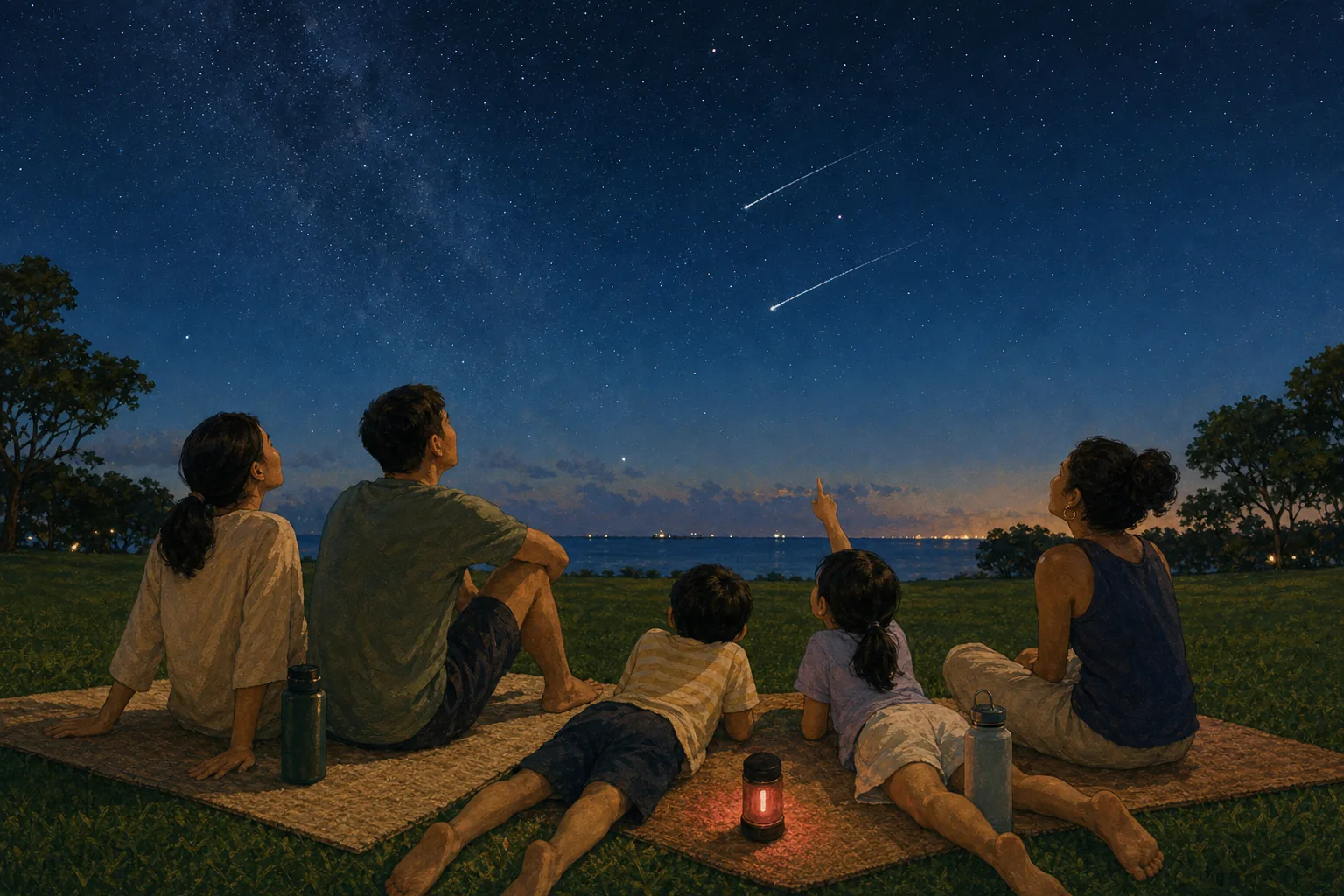
A worked example: five people, two plans
Illustrative example: the group and all costs except the stored ticket price are invented; timings are our calculation. Three adults and two children aged 8 and 10 want to see the Geminids.
- Plan A, Friday 11 December at the Science Centre: 5 tickets × S$17 = S$85, or S$17 each, if the "from" price listed in October 2026 still applies; both children need an adult with a ticket. The Geminids are active by then on IMO's dates but well short of the peak, so this is mostly a telescope night.
- Plan B, Monday 14 December in a 24-hour park: arrive at 11.30pm and watch from midnight to 2am on Tuesday 15 December, as the radiant climbs from about 37 to 55 degrees. Sunday 13 December is the backup night. Snacks and drinks S$24 and a late ride home S$36 come to S$60, or S$12 each (S$60 ÷ 5).
Monday falls in the school holidays, but a 2am night is a family decision. Our group cost splitter divides a longer list.
A checklist for the night
- Keep Sunday 13 and Monday 14 December free and decide each afternoon from the Meteorological Service's forecast.
- Choose open sky to the north-east and overhead, away from lamps, and arrive by about 11.30pm.
- Give your eyes about 30 minutes in the dark, which NASA says they need to adapt, and keep phone screens dim.
- Lie back on a mat and take in the whole sky.
- Bring mats, not a tent, to Changi Beach Park, and plan the journey home before you set out.
- For the Science Centre, book ahead: there is no refund for cloud or rain.
What about the Ursids and Quadrantids?
Neither is a good substitute. IMO's calendar puts the Ursid maximum at 6am on Wednesday 23 December in Singapore (22h UT on 22 December), two days before the full Moon, at about 5 to 10 an hour, and its shower calendar page calls them "strictly a northern-hemisphere event"; Singapore is barely north of the equator, and on our calculation from IMO's radiant position the Ursid radiant gets no higher than about 16 degrees here. The same page puts the Quadrantid peak near 3.30 UT on 4 January 2027, about 11.30am in Singapore, in daylight, with timing that favours Europe and western Asia.
For other December outings, see the Q4 2026 events calendar, our Science Centre tickets guide and the going-out topic page.
Common questions
When is the Geminid meteor shower in Singapore in 2026?
IMO puts the peak at 10pm on Monday 14 December 2026 in Singapore, but the radiant is low then, so on our calculation the hours after midnight on the nights of 13 and 14 December are better.
Can you see a meteor shower from Singapore?
Yes, mainly the brighter meteors; IMO's 150 an hour is an ideal rate, NASA expects 40 to 50 under dark skies, and with city lights and December cloud you should expect far fewer.
Does the Science Centre run stargazing in December?
Its page lists sessions every Friday from 7.30pm to 10pm unless otherwise stated, for ages 5 and above, with no refund if the weather is poor; it does not say whether the Christmas Day session runs.
Can I put up a tent at Changi Beach to watch the meteor shower?
No; Changi Beach Park's page says camping and tents are not allowed there, so bring mats instead.
Sources
- 2026 meteor shower calendar imo.net
- Geminids page science.nasa.gov
- 2026 calendar moe.gov.sg
- climate page weather.gov.sg
- East Coast Park nparks.gov.sg
- Changi Beach Park nparks.gov.sg
- Pasir Ris Park nparks.gov.sg
- West Coast Park nparks.gov.sg
- stargazing page science.edu.sg
- ticket shop programmes.tickets.science.edu.sg
- holidays page mom.gov.sg
- shower calendar page imo.net
Something changed or worth adding?
Send a correction or suggestion

